12 Small Bedroom Closet Organization Ideas for Renters
 Save
12 Small Bedroom Closet Organization Ideas for Renters
My first apartment closet was a joke with a door on it. One sad metal rod, one shelf I couldn’t reach without a chair, and a landlord whose lease said “no alterations” in the kind of bold font usually reserved for fire exits.
So I did what every renter does: I shoved everything in, closed the door fast, and pretended the avalanche risk was a personality trait.
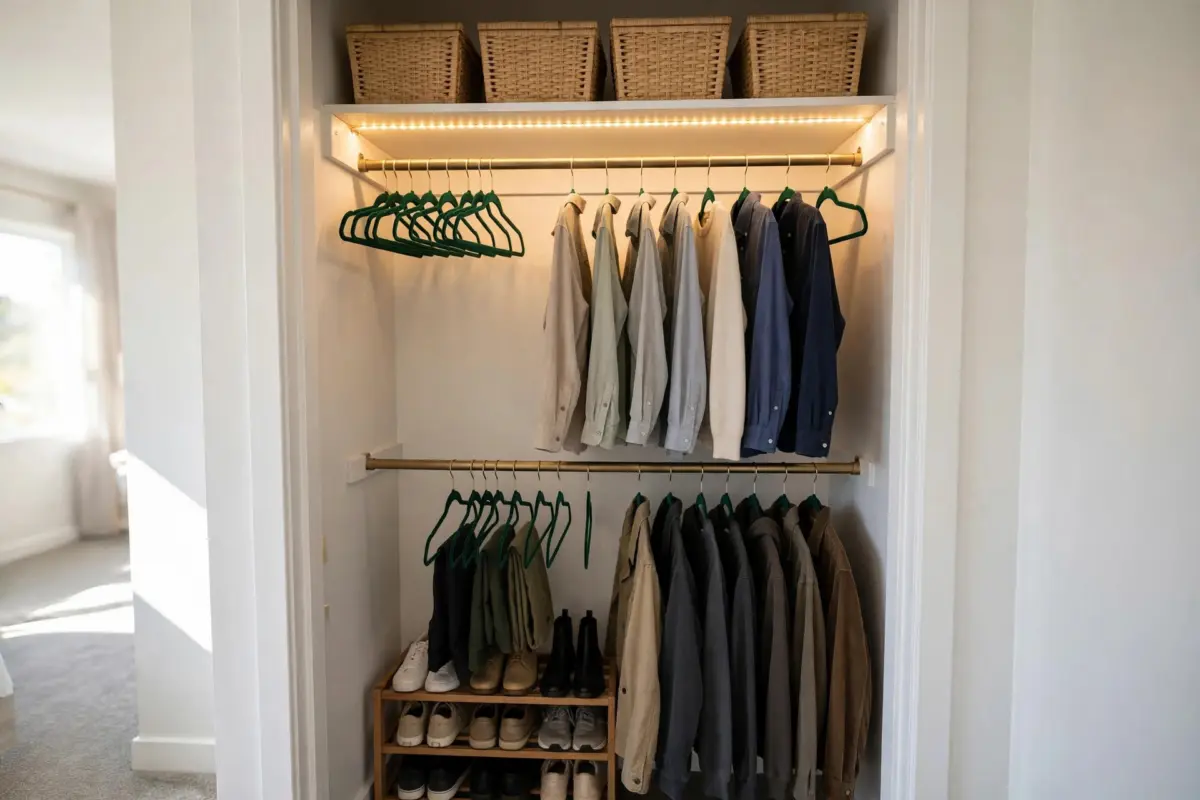
Two apartments later, I’ve learned the truth about builder-grade closets. The problem is almost never the square footage. It’s the vertical space. A standard reach-in closet — usually 48 to 60 inches wide with a single rod and one shelf — wastes about two-thirds of its height. Everything hangs at one level, the floor becomes a shoe graveyard, and the top shelf holds whatever you threw up there during your last move.
Everything below is renter-safe: no drilling, no built-ins, nothing your landlord can charge you for on move-out day. I’ve done most of these myself, and I’ve included the real prices and measurements I wish someone had handed me before my first Target run.
1. Add a Second Hanging Rod (The Double-Hang)
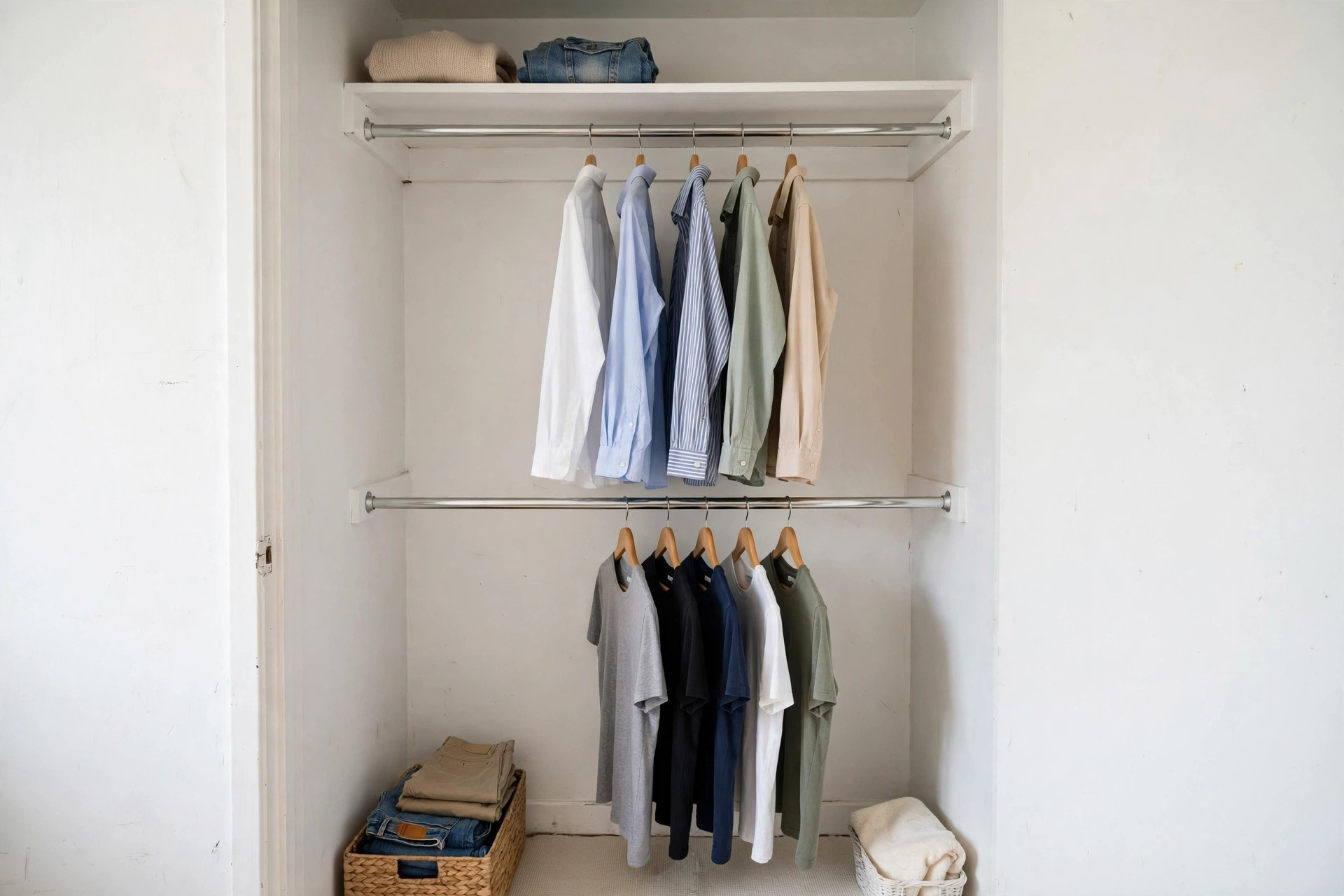
If you only do one thing from this list, do this. A second rod hung below your existing one turns the dead air under your shirts into a full second hanging zone — pants, skirts, and folded-over jeans get their own level. It’s the single highest-impact change you can make in a reach-in closet, and it’s the answer every professional organizer gives when asked for the one best small-closet idea.
The easiest version is a drop-on rod: it hangs from your existing rod by chains or straps, so there’s genuinely nothing to install. Measure your rod-to-floor distance first — you need about 40 inches of clearance below the top rod for shirts on the upper level and another 40 for the lower, so this works best when your closet is at least 80 inches tall inside. Most reach-ins are.
What to look for: adjustable width so it fits your exact rod span, and a weight rating of at least 30 pounds — a rod full of jeans is heavier than it looks. Drop-on rods run $18 to $25; Walmart’s BsBsBest hanging rod is $10.99 if your span is standard.
My mistake: my first double rod was a fixed-width one that was two inches too wide for my closet. It bowed in the middle within a month. Adjustable or nothing.
No room for a second rod? A simple tension rod wedged between the closet walls works as a lightweight second tier for scarves and camis — it’s the same tension-rod trick I use under my kitchen sink for spray bottles.
2. Swap Every Hanger for Slim Velvet
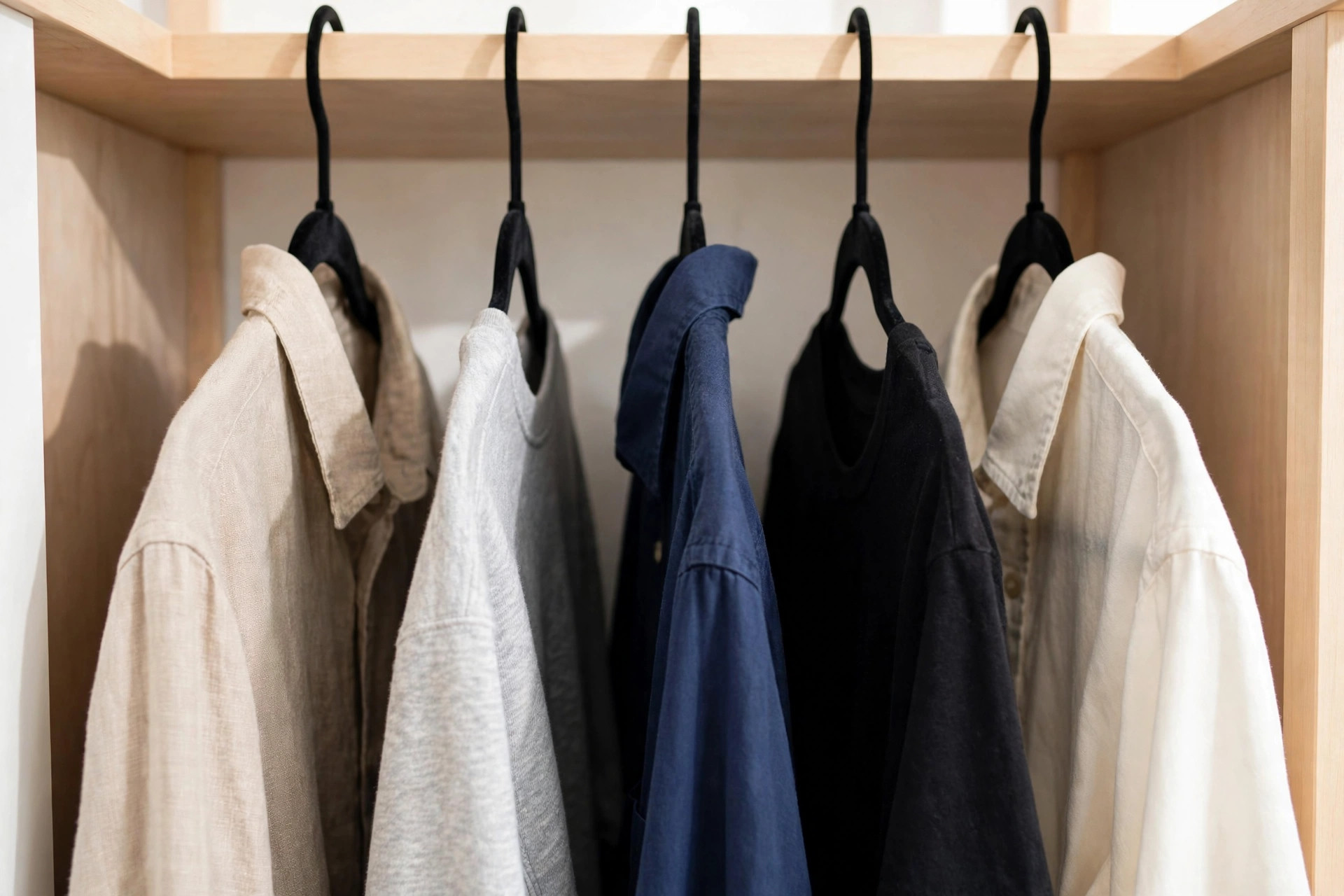
This is the closest thing to free closet space that money can buy. A standard plastic tube hanger is about half an inch thick; a slim velvet hanger is about a fifth of an inch. Across a 48-inch rod, that difference buys you room for roughly 20 to 30 more garments. It also stops the slow slide — velvet grips fabric so nothing ends up in a sad pile at the rod’s low point.
Do the swap in one go if you can. A rod of mixed hangers (five velvet, three plastic, one dry-cleaner wire situation) looks chaotic even when it’s technically organized, and the bulky ones eat the space the slim ones freed up.
What to look for: actual velvet or flocked coating (not just “slim” plastic — those slide), a 360-degree swivel hook, and shoulder notches for camis. The Amazon Basics 50-pack runs about $15.41 when it’s on deal, which covers most of a reach-in closet in one box. The 30-pack is around $17.71 if you need fewer.
The rule that keeps it working: one in, one out for hangers. When the velvet hangers run out, something old leaves before anything new gets hung. It’s the only system that’s ever stopped my closet from creeping back to chaos.
3. Hang a Fabric Shelf Organizer From the Rod
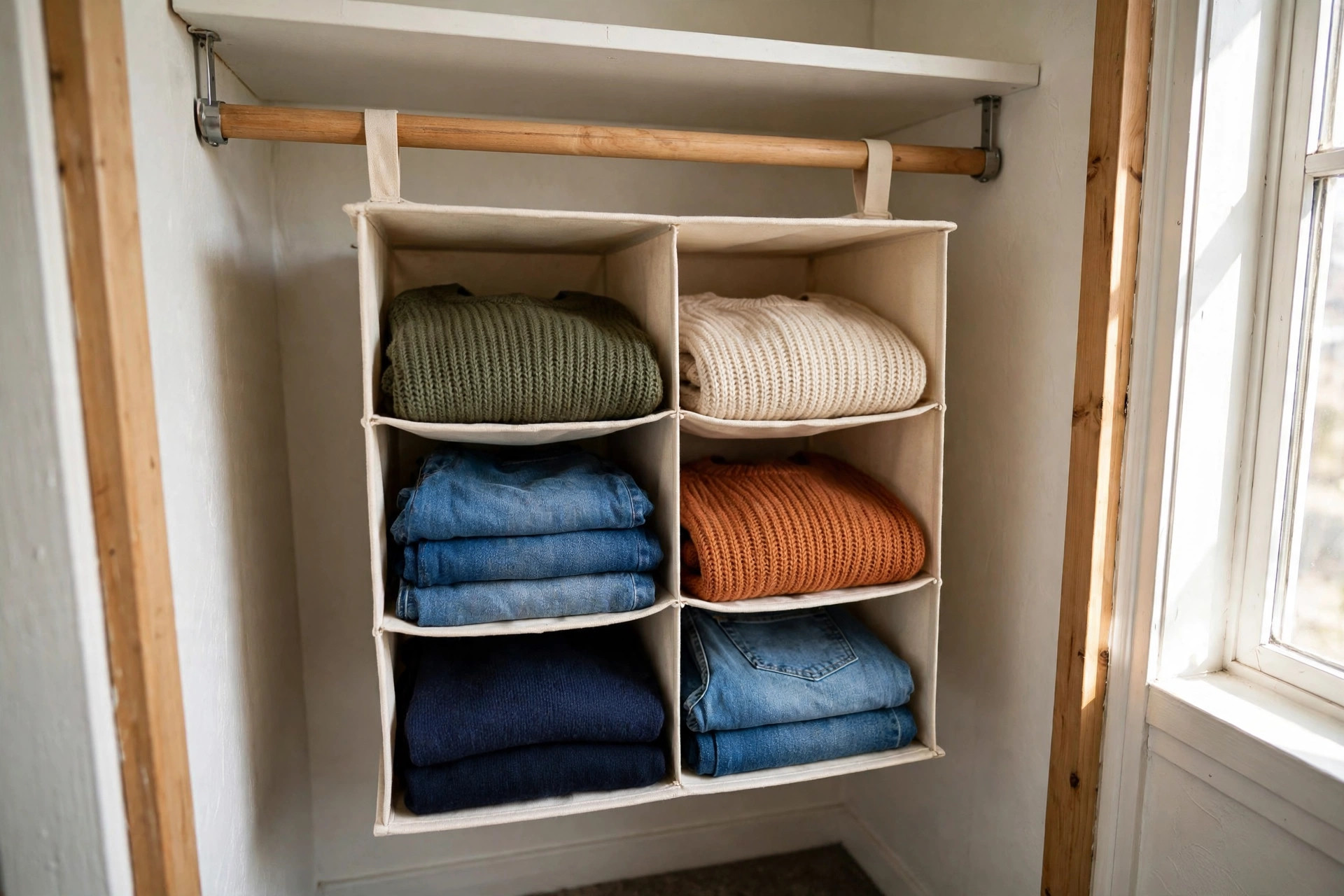
A fabric hanging organizer is instant shelving with zero installation — it just loops over the closet rod and hangs there. The cubbies are perfect for everything that shouldn’t be on a hanger: folded tees, knit sweaters, jeans, handbags, clutches. Six shelves of folded knits take up about 12 inches of rod width, which is the best space trade in this entire list.
This is also where your “semi-clean” clothes can live — the jeans you’ve worn once and the sweater that’s fine for one more day. Giving almost-clean clothes a real home (instead of the chair) is a small change that makes the whole closet feel calmer.
What to look for: reinforced shelves that don’t sag in the middle, and side pockets if you can find them — they’re great for belts and sunglasses. Walmart’s 6-shelf version is $7.97, Target’s Brightroom runs $15 to $19, and the SpaceAid 7-shelf is $29.99 if you want the extra tier.
Placement tip: hang it at one end of the rod, not the middle. It becomes a natural divider between your hanging zones and it doesn’t block access to the clothes behind it.
4. Divide the Top Shelf With Shelf Dividers
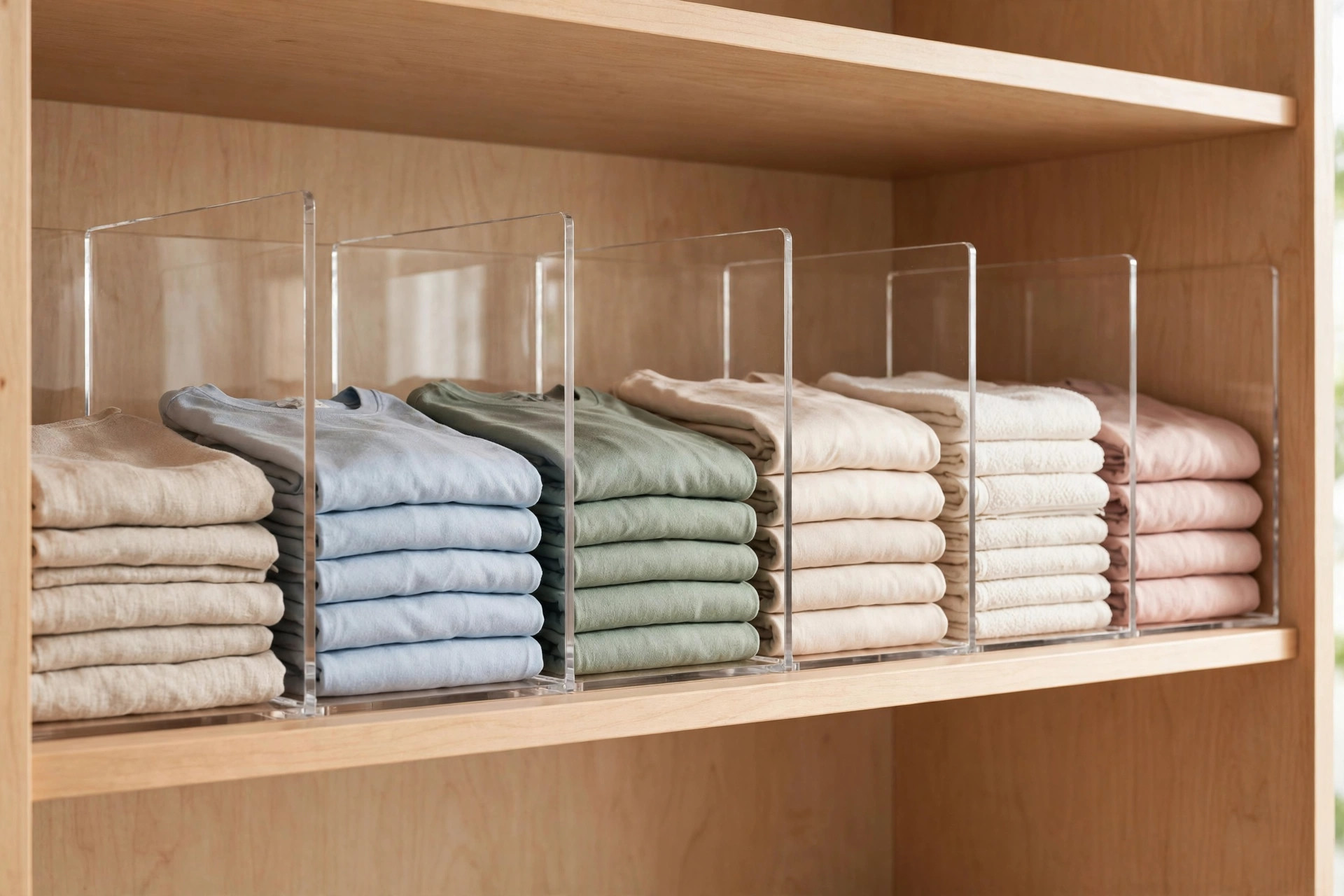
The top shelf of a reach-in closet is where folded stacks go to die. You pile sweaters neatly, pull one from the middle, and the whole stack avalanches by Thursday. Shelf dividers — clear acrylic panels that slide onto the shelf — turn that one long ledge into tidy compartments that hold their shape.
They’re especially good for the stuff you fold in stacks: sweaters, hoodies, jeans, linens. Each stack gets its own slot, and pulling from the bottom of a stack stops being a demolition event.
What to look for: slide-on style (no screws, no adhesive), sized for your shelf depth — most reach-in shelves are 12 inches deep, and a divider made for a deeper shelf will wobble. Walmart’s clear acrylic 2-pack is $6.96, which handles most of a 48-inch shelf. Target’s J&V Textiles dividers run $32.99 to $38.49 if you want the sturdier set.
My mistake: I bought dividers for a 16-inch shelf and put them on my 12-inch one. They seesawed every time I touched them. Measure the depth (see the measuring section below) before you buy.
5. Put an Over-the-Door Pocket Organizer on the Closet Door
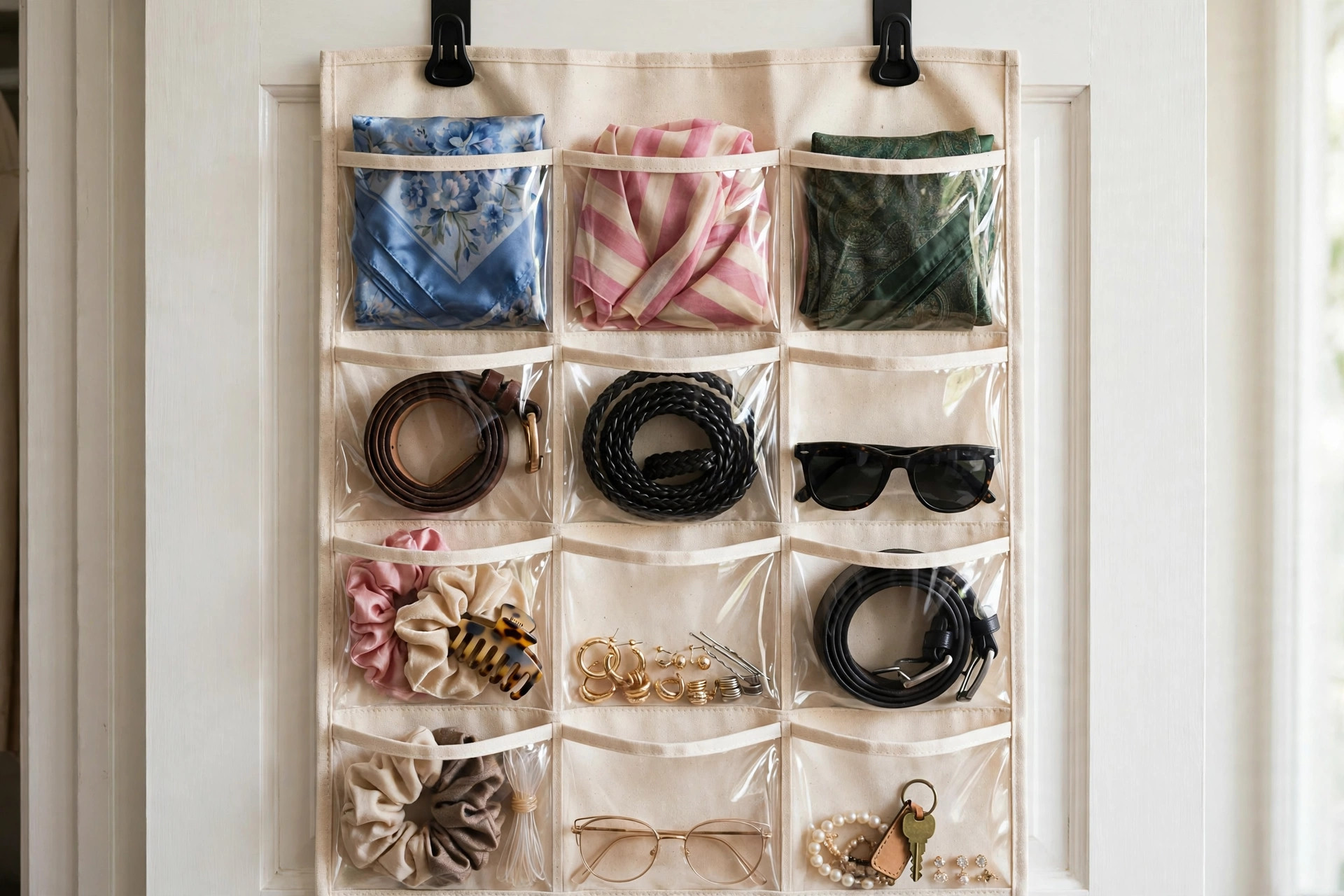
The back of your closet door is square footage you’re already paying rent on and not using. An over-the-door pocket organizer turns it into storage for shoes, scarves, belts, sunglasses, rolled-up tees — all the small stuff that clutters shelves and drawers.
Clear pockets beat fabric ones here. If you can see the item, you’ll actually grab it; if it’s hidden in an opaque pocket, you’ll forget it exists and buy a duplicate. That’s not a theory — I’ve owned three identical black belts at the same time.
What to look for: hooks that fit your door — measure the gap above the door and the door’s thickness before buying, because a tight frame will bind and a thick door won’t take standard hooks. You need roughly a quarter inch of clearance up top. Target’s SpaceAid 5-pocket organizer runs $24.99 to $45.98 depending on size.
Renter check: open and close the door fully after hanging it. If the organizer bangs against the frame, pad the contact points with felt dots — a two-dollar fix that saves your door and your security deposit.
6. Hang an Over-the-Door Hook Rack for Daily Stuff
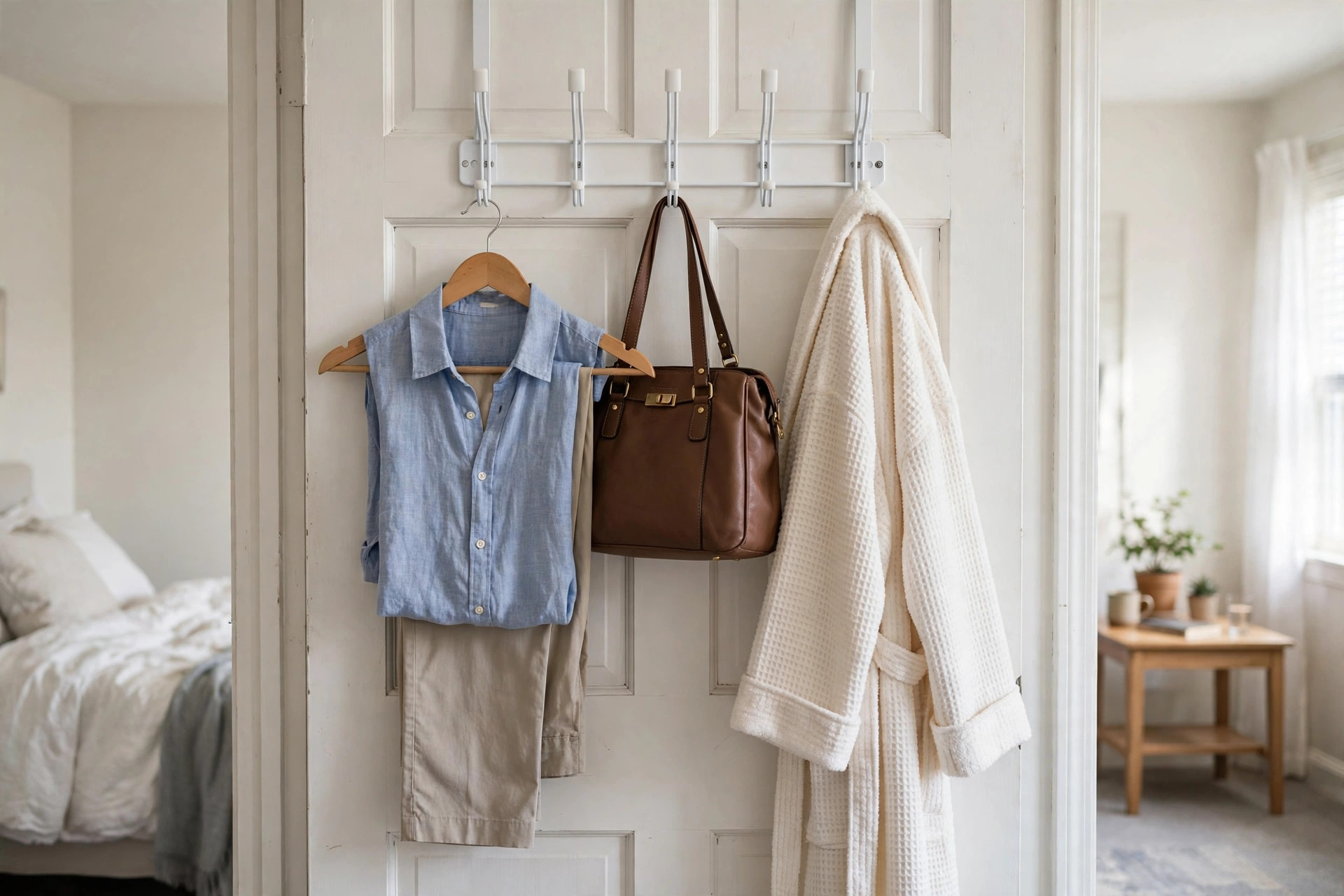
Different job from the pocket organizer: this is for the things you grab every single day. Your robe, tomorrow’s outfit, the tote bag, the jacket that’s in rotation this week. A hook rack with 4 to 6 sturdy hooks on the inside of the closet door (or the bedroom door) keeps daily items off the floor and off the bed.
I hang tomorrow’s outfit on mine every night. It takes thirty seconds and it ends the “chair pile” problem permanently — you know the chair. Everyone has the chair.
What to look for: hooks rated for at least 5 pounds each (a wet towel or a heavy tote will defeat flimsy ones), and a rack that sits flat against the door so it doesn’t swing. Expect to spend $10 to $25 for a decent one.
The habit that makes it work: this rack is for active rotation only — five items max. The moment something hasn’t been touched in a week, it goes back on a hanger or in a drawer. A hook rack of forgotten clothes is just a vertical chair pile.
This is the closet version of the landing strip by my front door — same principle, same thirty-second habit. If you haven’t set one up yet, my entryway ideas walk through the whole system.
7. Use a Slim Tiered Shoe Rack on the Floor
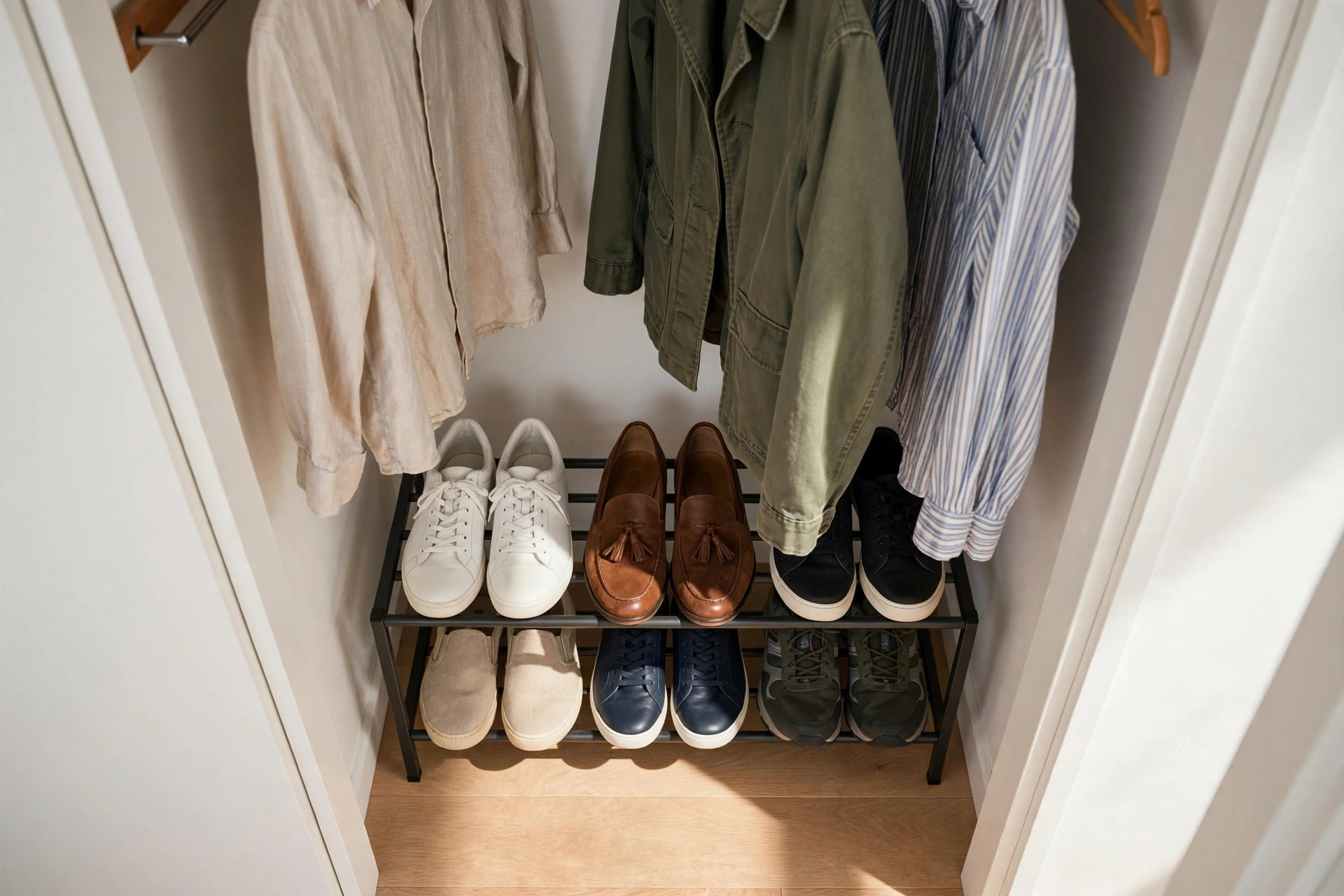
Shoes on a closet floor multiply like rabbits. A slim tiered rack with angled slots cuts each pair’s footprint roughly in half, because one shoe sits above the other instead of side by side. Two tiers hold 8 to 10 pairs in the same floor space that used to hold four pairs kicked sideways.
Stackable is the key word for renters. A single-tier rack that you can double later grows with your collection, and it all comes apart flat on moving day.
What to look for: angled slots (flat shelves don’t save space), a width that fits your closet’s floor zone — measure the clear floor between the walls — and a frame that doesn’t wobble when loaded. Target’s single stackable rack is $7; the 4-tier Brightroom is $45 if you want the whole tower at once.
What goes on the floor vs. the door: daily shoes live on the rack where you can grab them; occasion shoes (heels, boots, the fancy ones) go in the over-door pockets from idea #5. Splitting by frequency keeps the floor rack from overflowing.
No clear floor in the closet at all? The same slim rolling cart I use in my bathroom fits the gap beside most closets and swallows shoes, bags, or cleaning supplies — narrow gaps are storage if you think vertically.
8. Store Off-Season Clothes in Labeled Bins on the Top Shelf
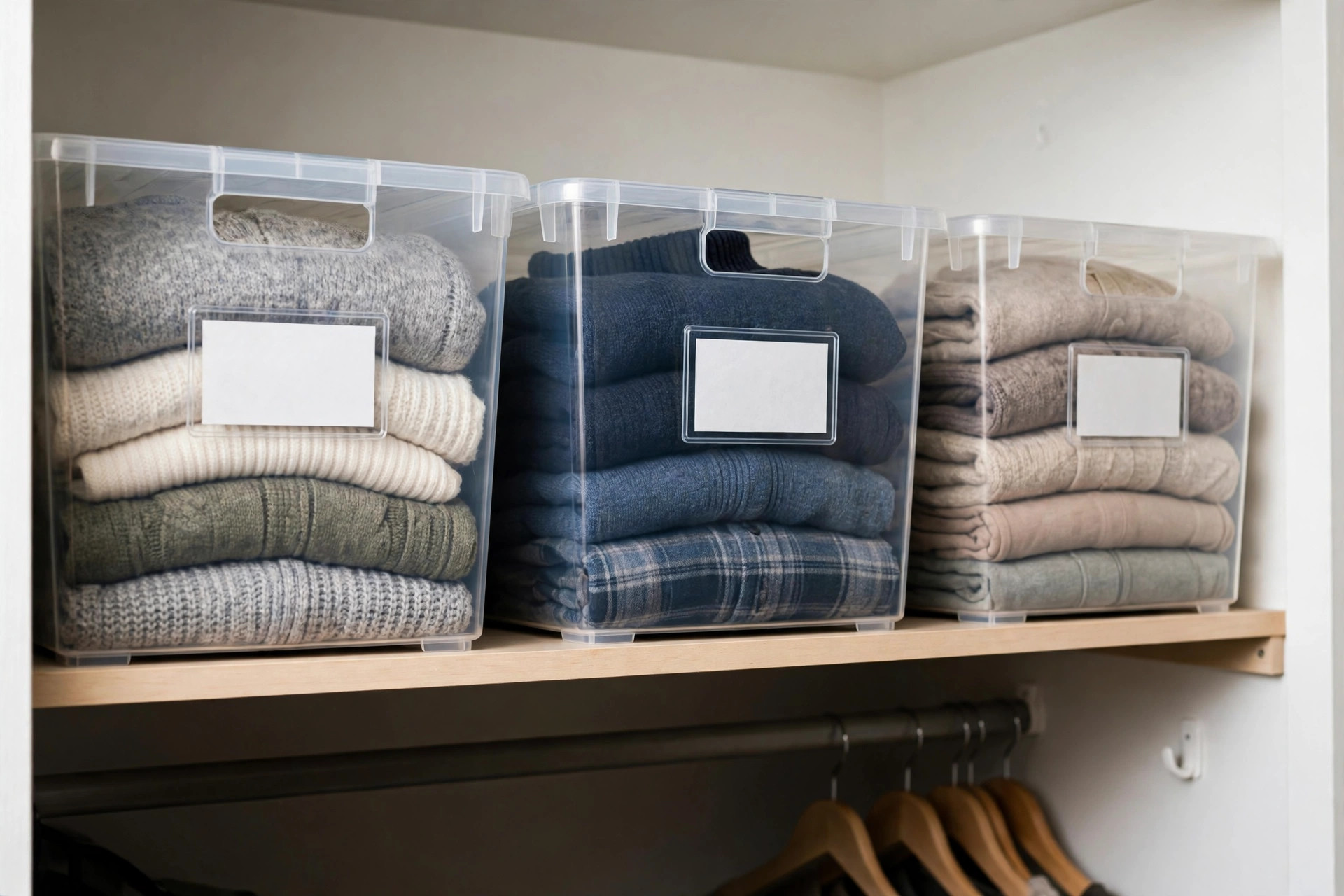
Here’s the mindset shift that changed my closet: only the current season lives on the rod. Everything else — the puffers in April, the linen in November — gets folded into bins on the top shelf. A reach-in closet can’t hold a full year of clothes, and it was never supposed to. Seasonal rotation is the system.
Matching bins matter more than you’d think. Uniform bins with labels read as “organized” even when the contents are just folded chaos inside. Label them by season or category — “Winter knits,” “Swim + vacation,” “Heavy coats” — so you can find things without opening all four.
What to look for: bins that fit your shelf depth (12 inches is standard — measure), with lids to keep dust off, and a label holder or a flat side for a label. Target’s Brightroom 3-pack is $20; the Y-Weave bins are $5 to $9 each if you want to buy exactly the number you need.
The rotation ritual: twice a year, one hour. Swap the seasons, wipe the shelf, donate anything you didn’t wear. Put the off-season bins you won’t touch for months in the hardest-to-reach spot — prime shelf space is for the current season only. If your top shelf overflows, lidded bins stack neatly inside a storage ottoman in the living room until the season turns.
9. Reclaim Dead Air With Under-Shelf Hanging Baskets
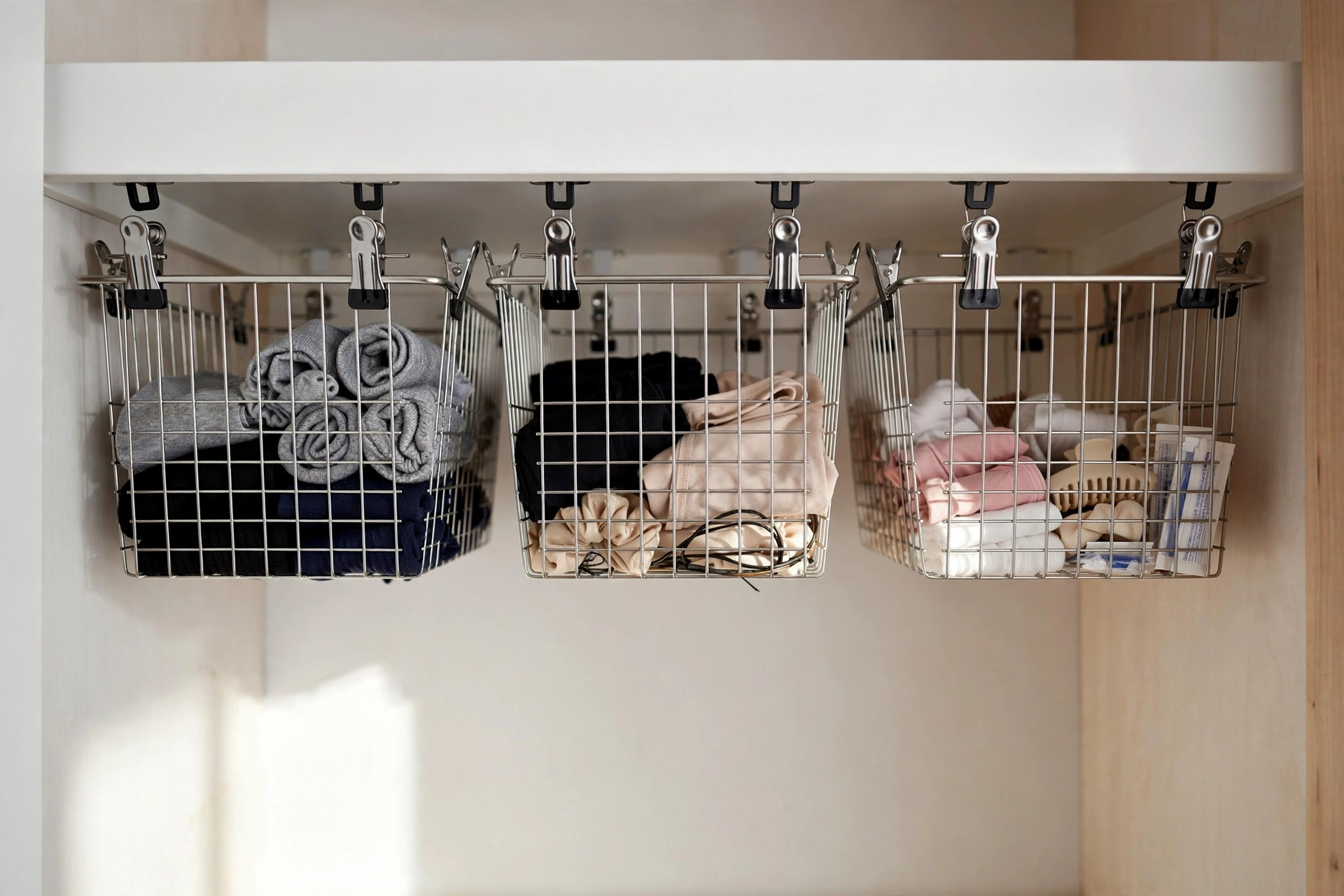
There’s a gap under every closet shelf that’s too short for hanging clothes and too awkward for stacking — usually 8 to 12 inches of nothing. Under-shelf hanging baskets hook onto the shelf above and turn that dead air into drawers for tees, leggings, underwear, socks, and accessories.
They slide like drawers, so you can see everything without unstacking. That’s the whole game in a small closet: visibility. Every item you can’t see is an item you’ll forget and rebuy.
What to look for: arms that grip your shelf thickness securely — most are made for standard 12-inch wire or wood shelves — and a basket depth that doesn’t block the rod below. Walmart’s Bexikou under-shelf basket is $17.99.
What lives here: the small, slippery stuff. Socks, underwear, camisoles, leggings, rolled tees. One basket per category, and the “digging through a drawer” era of your mornings is over.
10. Compress Bulky Off-Season Gear in Vacuum-Seal Bags
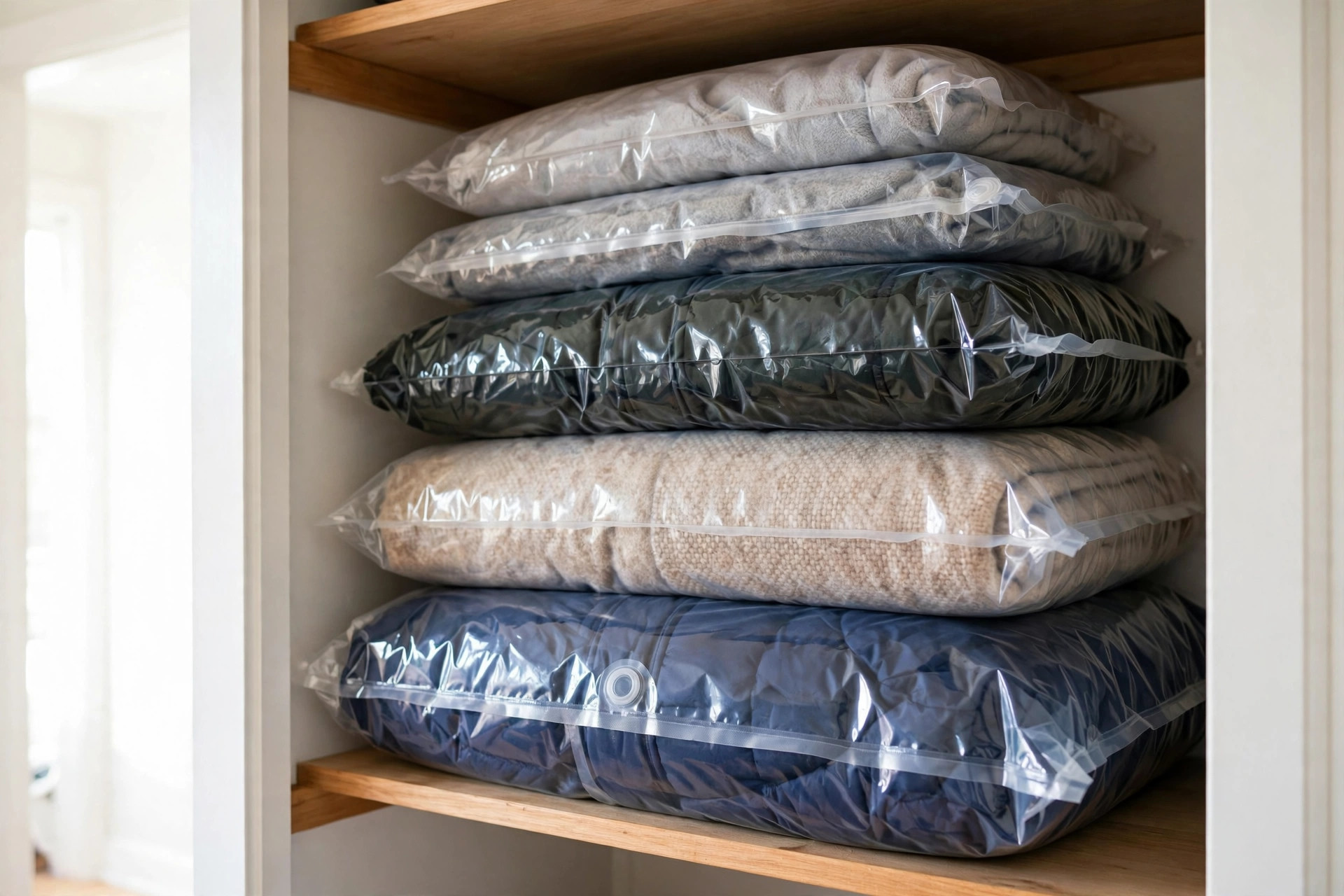
Puffers, heavy sweaters, and winter bedding are closet killers — three sweaters can eat a whole shelf. Vacuum-seal bags compress bulky soft goods by roughly 80%. A flattened bag the size of a laptop holds what used to fill a laundry basket.
Roll the air out through the valve (most come with a small hand pump, or your vacuum cleaner’s hose works), seal it, and slide the flat bags onto the top shelf or under the bed. They stack like files, they keep dust and mustiness out, and they make the seasonal rotation from idea #8 dramatically smaller.
What to look for: a valve that actually reseals (cheap bags leak air back in within weeks), and bags sized for what you’re compressing — jumbo for comforters, large for coats. Target’s Brightroom 3-pack is $12 to $15; the SpaceAid 14-pack with a pump is $29.99 if you’re doing a full seasonal purge.
Don’t vacuum-seal: anything with down you care about long-term (compression damages the loft over months), leather, or anything you’ll need in the next few weeks. Vacuum bags are for deep storage, not daily access.
11. Add Battery LED Lights So You Can Actually See
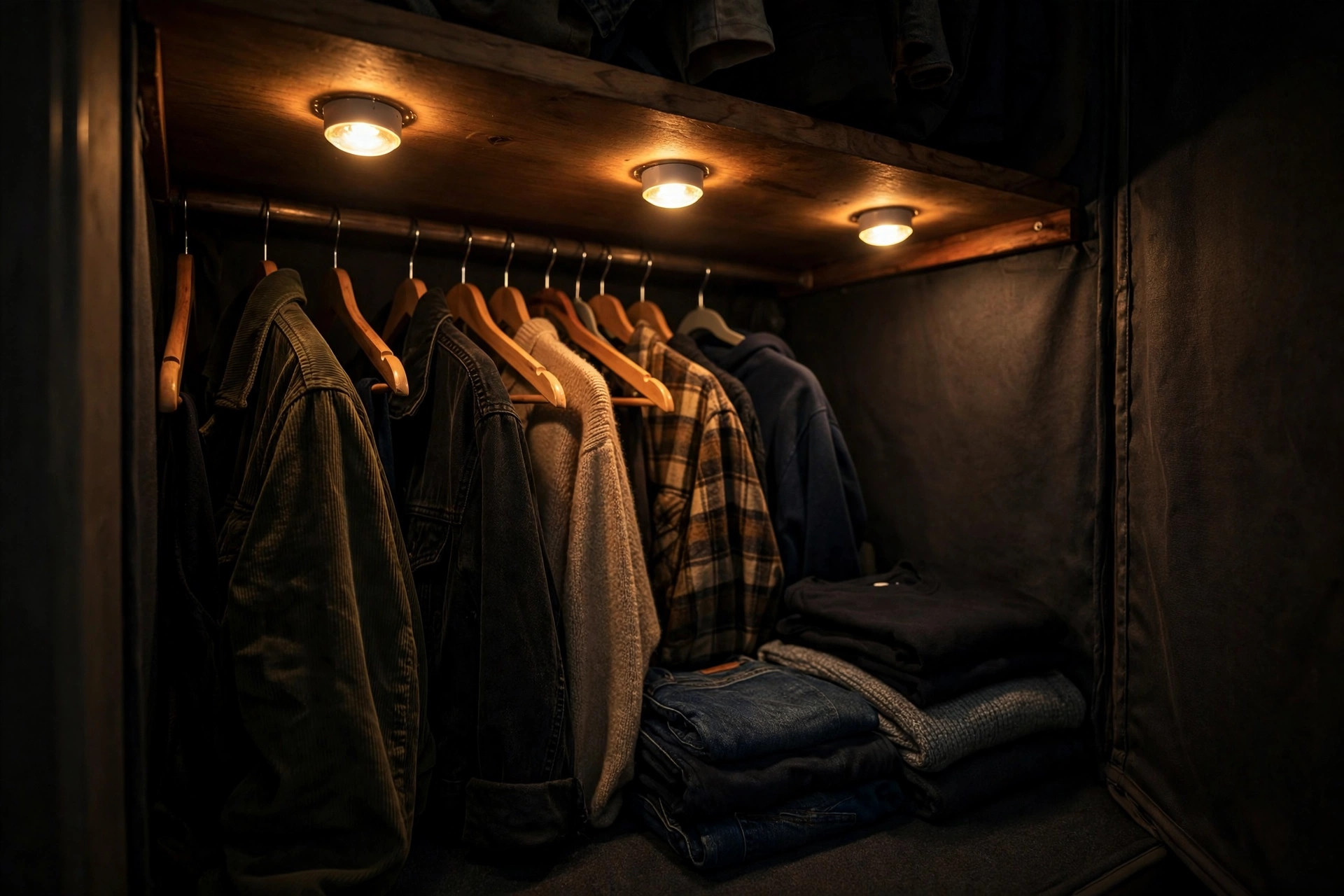
Most reach-in closets have no light, or one sad bulb in the hallway outside. A dark closet is an unused closet — you can’t wear what you can’t see, so the back half becomes a graveyard of forgotten clothes. Battery-powered LED puck lights or adhesive strip lights fix this for under $20 with zero wiring.
Stick two or three puck lights under the top shelf, or run a strip along the inside of the door frame. Motion-sensor versions turn on when you open the door, which feels unreasonably luxurious for something that costs less than a pizza.
What to look for: warm white (3000K-ish — cool white makes clothes look wrong), adhesive or magnetic mounting, and a battery life you can live with. Target’s Energizer 2-pack is $6.99 to $9.99; a rechargeable 6-pack on Amazon runs about $18 and saves you from buying batteries forever.
Placement matters more than brightness: one light under the shelf beats three on the back wall. You want light falling on the clothes, not glaring in your eyes when the door opens.
12. Build an Accessory Station With Command Hooks on the Side Wall
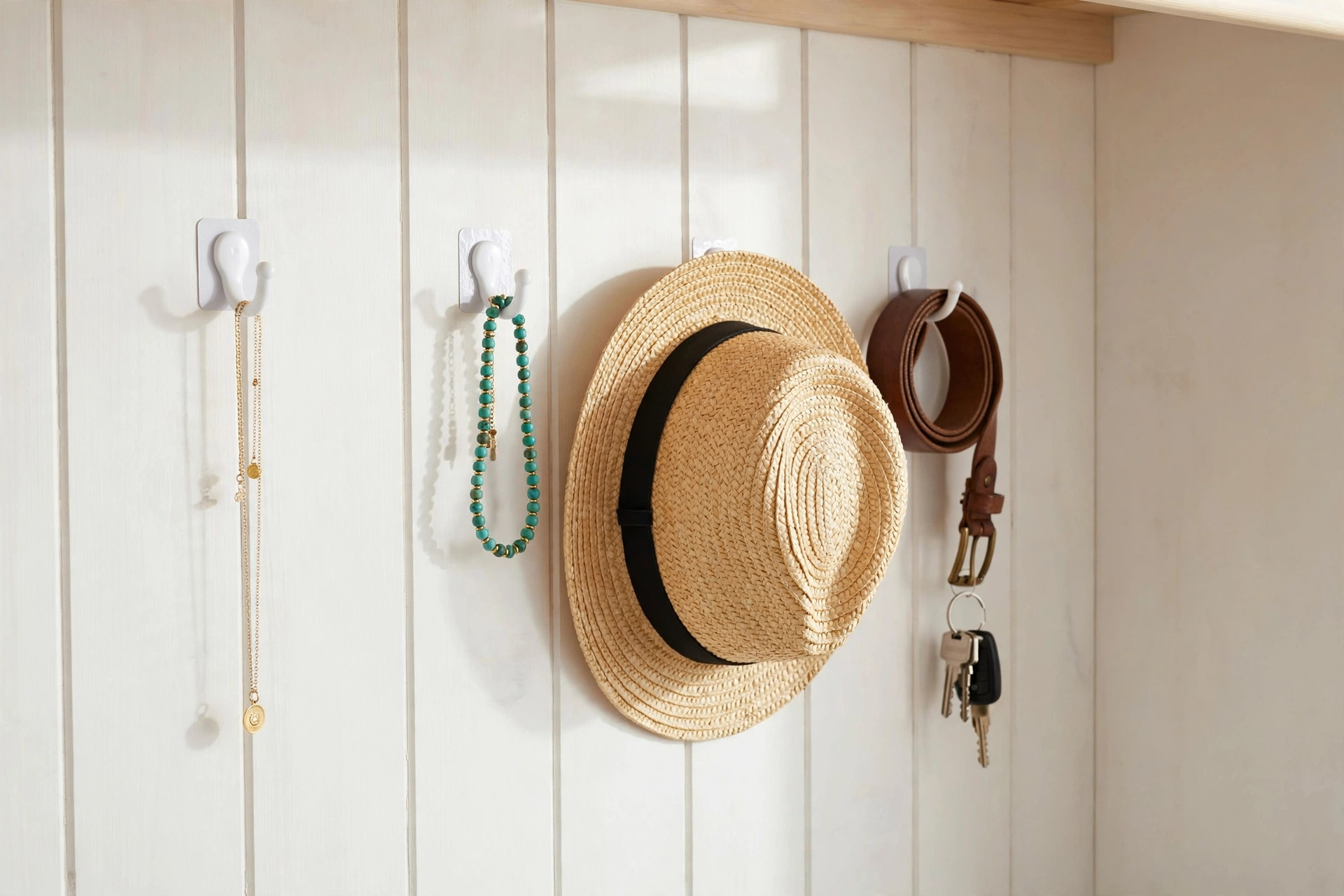
The side walls of a reach-in closet are almost always blank — and they’re perfect for the small stuff that tangles, disappears, or lives in a junk drawer. A row of small clear adhesive hooks holds necklaces (no more tangled chains), belts (hung by the buckle), sunglasses, and handbags by their straps.
This is the cheapest idea on the list and one of the most satisfying. A wall of visible, untangled accessories means you actually wear them instead of grabbing the same two necklaces every day because they’re the only ones you can find.
What to look for: small clear mini hooks rated for the weight — bags need the larger sizes, necklaces are fine on minis. A mixed pack for $4 to $8 covers a whole side wall. Follow the cure time on the package (usually an hour) before hanging anything, and pull the tab straight down slowly on move-out day.
Layout tip: group by type, not by color — all belts together, all necklaces together. And leave one empty hook. There’s always one more bag.
Measure Before You Buy: 3 Numbers That Matter
The number-one renter closet mistake is buying organizers that don’t fit. Every idea above depends on three measurements. Take them once, write them in your phone, and bring them to the store (or keep the tab open while you shop online).
1. Rod length, wall to wall. This determines whether a double-hang rod fits, how many hangers you can buy, and whether a tension rod will span. Most reach-ins are 48 to 60 inches. As a baseline, plan on about 40 inches of rod per person — so a couple sharing a 48-inch closet is going to feel it, and that’s a sign to lean harder on the door and shelf ideas.
2. Shelf depth. Reach-in shelves are usually 12 inches deep. This number controls which bins, dividers, and baskets will sit flat without overhanging. Anything deeper than your shelf wobbles; anything much shallower wastes space.
3. Door-top gap and door thickness. This decides which over-the-door hooks and organizers will fit. You need roughly a quarter inch of clearance above the door, and standard hooks assume a standard interior door thickness. Thick or non-standard doors need specialty hooks — better to know before you buy than after you’ve ripped the packaging.
The 20-minute pre-shop routine: photograph the empty closet from three angles, sketch the measurements on paper, and note where the light does and doesn’t reach. Twenty minutes of measuring saves a weekend of returns — I know, because I’ve done the returns weekend. Twice.
The $75 Starter Kit: What to Buy First
You don’t need all twelve ideas on day one. Buy in this order and you’ll feel the difference immediately, for about $75 total:
1. Slim velvet hangers, 50-pack — ~$15. The single best dollars-to-space ratio in this list. Do this first, before anything else.
2. Double-hang rod — $18 to $25. Doubles your hanging space overnight. The BsBsBest rod at $10.99 works if your span is standard.
3. Over-the-door pocket organizer — $10 to $25. Unlocks the door as a storage wall for shoes and accessories.
4. Two labeled bins — ~$10 to $15. Starts the seasonal rotation habit on the top shelf.
Total: roughly $60 to $80. That’s a transformed closet for less than a nice dinner out.
Tighter budget? The ~$30 dollar-store tier: a $2.97 tension rod as a second tier for lightweight items, a $6.96 2-pack of acrylic shelf dividers, and two $5 bins. It won’t do everything the full kit does, but it fixes the worst of the chaos.
Ready to go further? The ~$150 full system: add the starter kit plus a $7 stackable shoe rack, $7 to $18 in LED lights, $12 to $30 in vacuum bags, and a $29.98 Sterilite drawer tower for the closet floor. That’s every idea on this list that costs money, and it’s still cheaper than one custom closet consultation.
5 Mistakes That Shrink a Small Closet
Keeping off-season clothes on the rod. If your January closet holds July’s linen, you’re storing two wardrobes in a one-wardrobe space. Fix: bins on the top shelf, rotated twice a year (idea #8).
Stacking in deep piles instead of front-facing rows. A 14-inch-deep pile means you wear the top three items and forget the rest. Fix: shelf dividers and file-folding so every item’s edge faces you (idea #4).
Mismatched bulky hangers. Five thick plastic hangers eat the rod space of fifteen slim ones, and wire hangers stretch shoulders out. Fix: one full swap to slim velvet (idea #2).
Ignoring the back of the door. It’s the largest unused surface in most closets. Fix: pocket organizer for small stuff, hook rack for daily stuff (ideas #5 and #6).
No light. A dark closet is a closet you don’t fully use — the back half becomes invisible storage for clothes you forgot you own. Fix: two battery puck lights under the shelf, under $10 total (idea #11).
FAQ
What is the best way to maximize closet space in a small apartment? Go vertical. A reach-in closet wastes most of its height, so the biggest wins are a double-hang second rod, slim velvet hangers, and using the door and top shelf. Seasonal rotation — only the current season on the rod — effectively doubles what the closet can hold.
Are slim hangers worth it for small closets? Yes, and it’s not close. Slim velvet hangers are about a fifth of an inch thick versus half an inch for plastic tubes, which frees room for 20 to 30 more garments on a standard rod. They also grip fabric so clothes stop sliding into a pile. A 50-pack is around $15 — the cheapest space you’ll ever buy.
How do renters organize closets without drilling? Everything in this list is drill-free: drop-on double rods, over-the-door organizers and hooks, tension rods, freestanding shoe racks, adhesive hooks and LED lights, and bins and dividers that sit on shelves. Nothing here touches the walls with more than a removable adhesive strip.
What should NOT be stored in a small closet? Off-season clothes (bin them), anything damp (closets trap moisture — never store wet shoes or towels), and “maybe someday” items you’re keeping out of guilt. If you haven’t worn it in a year and it’s not formalwear, it doesn’t earn rod space.
What is the best way to store shoes in a small closet? Split by frequency: daily shoes on a slim tiered rack on the floor (angled slots halve each pair’s footprint), occasion shoes in over-the-door pockets. If the floor has no room, the door pockets can handle the whole collection.
Are closet organizer systems worth it for renters? The big built-in systems aren’t — you can’t take them with you and most need drilling. But a modular, removable system (double rod + hangers + door organizer + bins, about $75) absolutely is. Every piece moves with you to the next apartment.
How do I share a small closet with a partner? Divide and assign. Plan on about 40 inches of rod per person as a baseline, split the rod with a hanging organizer as a physical divider, and give each person their own shelf zone and door hooks. The non-negotiable rule: each person’s off-season stuff leaves the shared space entirely.
Can I really do a full closet makeover for under $100? Yes. The $75 starter kit above (velvet hangers, double rod, over-door organizer, bins) is a complete transformation, and most people finish the actual install in about 85 minutes with zero tools. The expensive part was never the organizers — it was not having a plan.
A small closet isn’t a storage problem — it’s a vertical-space problem. Measure first, start with the $75 kit, and rotate the seasons. Your landlord never has to know, your deposit stays safe, and getting dressed in the morning stops feeling like an excavation.
Loved this? Pin it so you can find it later.
Pin this post
Zoya Siddiqui
Hi, I'm Zoya Siddiqui, the founder of Shutki. I live in small rental spaces and share practical, renter-friendly storage ideas for tiny kitchens, bedrooms, closets, and bathrooms — no drilling, no renovations, no lost security deposit.
All postsKeep reading