No Coat Closet? 10 Entryway Organization Ideas for Small Apartments
 Save
No coat closet is the rental rite of passage. You walk in with your keys, your bag, your jacket, your shoes — and there’s nowhere for any of it to go. So it goes on the floor. Then on the chair. Then it becomes a permanent installation called “the pile.”
I’ve lived the no-closet life in three apartments. Here’s what actually works: you don’t need a closet, you need a system — a small, deliberate zone near the door where everything has a home. These 10 ideas build that zone with zero drilling and zero permanent changes.
The 2-Minute Entryway Audit
Before buying anything, stand at your door with your stuff and answer three questions:
- Where do keys land? If the answer is “wherever,” that’s problem one.
- Where do shoes live? If they’re a trip hazard, that’s problem two.
- Where do bags and jackets go? If it’s the floor or the sofa, that’s problem three.
Your entryway system needs exactly three homes: keys, shoes, and grab-and-go (bag/jacket). Everything else is bonus. Measure your entryway wall — most solutions below need 2 to 4 feet of width.
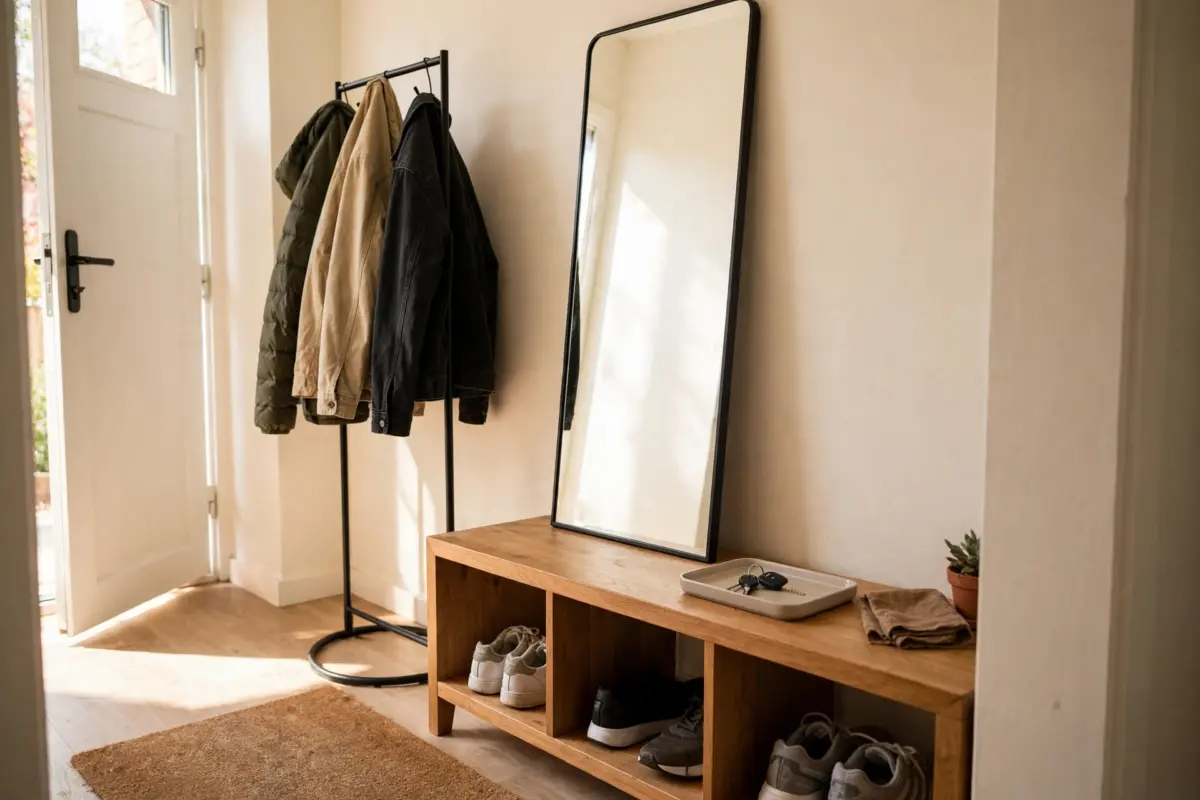
1. A Freestanding Coat Rack (The Obvious Fix That Works)
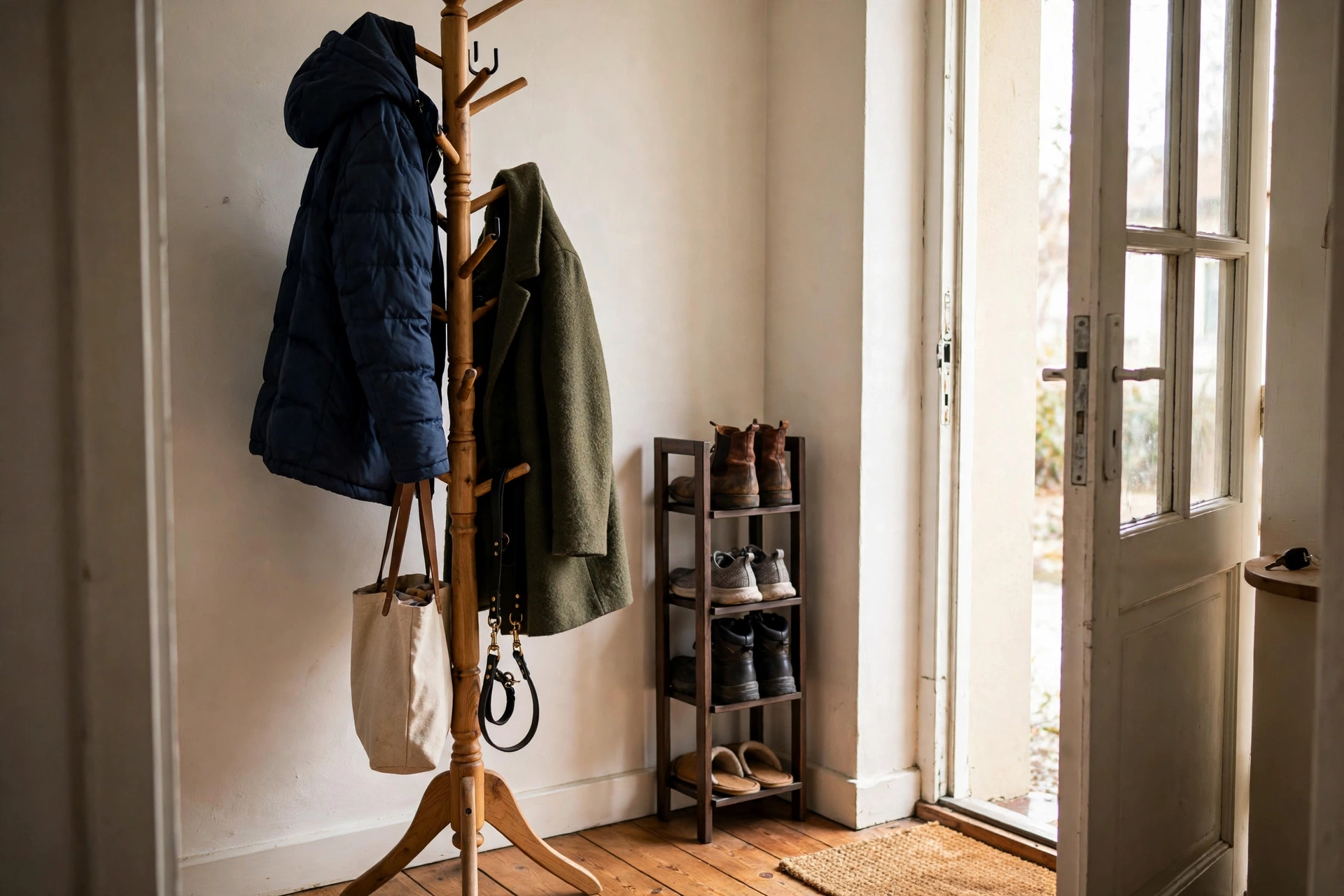
Sometimes the obvious answer is the answer. A freestanding coat rack holds 6 to 8 jackets and bags, needs zero installation, and moves with you. The trick is picking a stable one — cheap tripod racks tip over when loaded.
Look for a wide base (at least 18 inches) or a tree-style rack with a heavy bottom. $25 to $50. Put it within arm’s reach of the door, not across the room — if it’s not convenient, the pile wins.
Stability test: load it with your heaviest winter coats in the store (or right after delivery). If it wobbles, return it. A falling coat rack at 2am is a special kind of heartbreak.
2. A Storage Bench With Cubbies
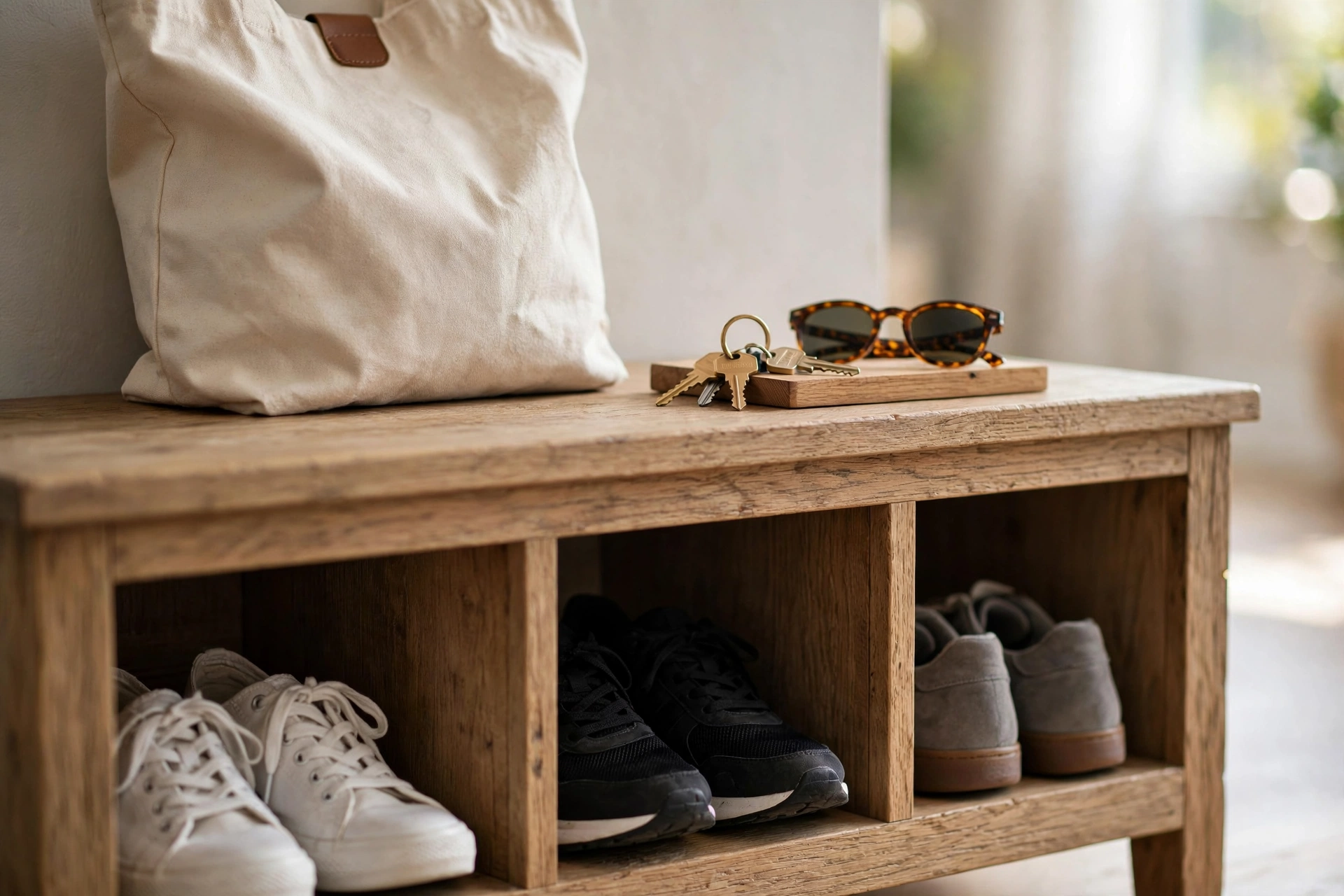
The entryway workhorse: sit to put on shoes, stash shoes in the cubbies, drop your bag on top. One piece of furniture, three jobs. A 2-cube or 3-cube bench runs $40 to $80.
Add a cushion on top ($15) and it becomes the “put your shoes on” spot that keeps shoe-chaos contained. Without a designated shoe spot, shoes migrate. With one, they mostly stay.
Sizing: 30 to 36 inches wide fits most entryways. Measure your door swing first — a bench that blocks the door is worse than no bench.
3. Adhesive Hook Strip for Bags and Keys
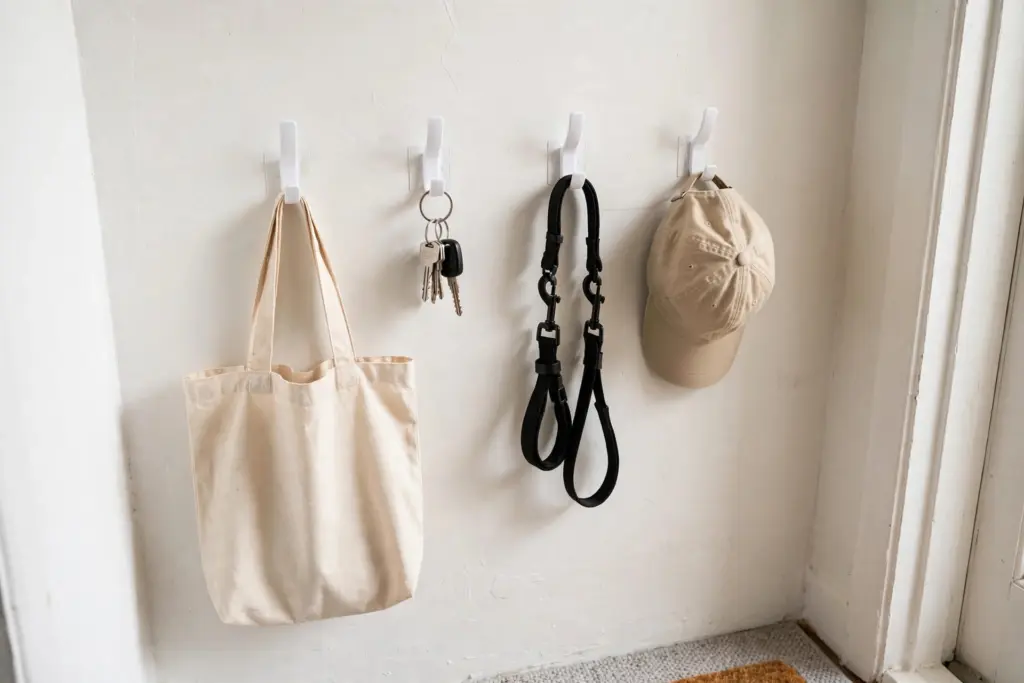
A row of 4 to 6 removable adhesive hooks near the door handles bags, dog leashes, umbrellas, and the jacket you wear daily. Heavy-duty strips hold 3 to 5 pounds per hook.
Keys go on the lowest hook or a small adhesive key holder — the rule is keys never touch a flat surface. Flat surfaces are where keys go to become “lost.” $10 to $15 all-in, 10-minute install, zero damage.
4. A Slim Shoe Cabinet (Not a Rack)
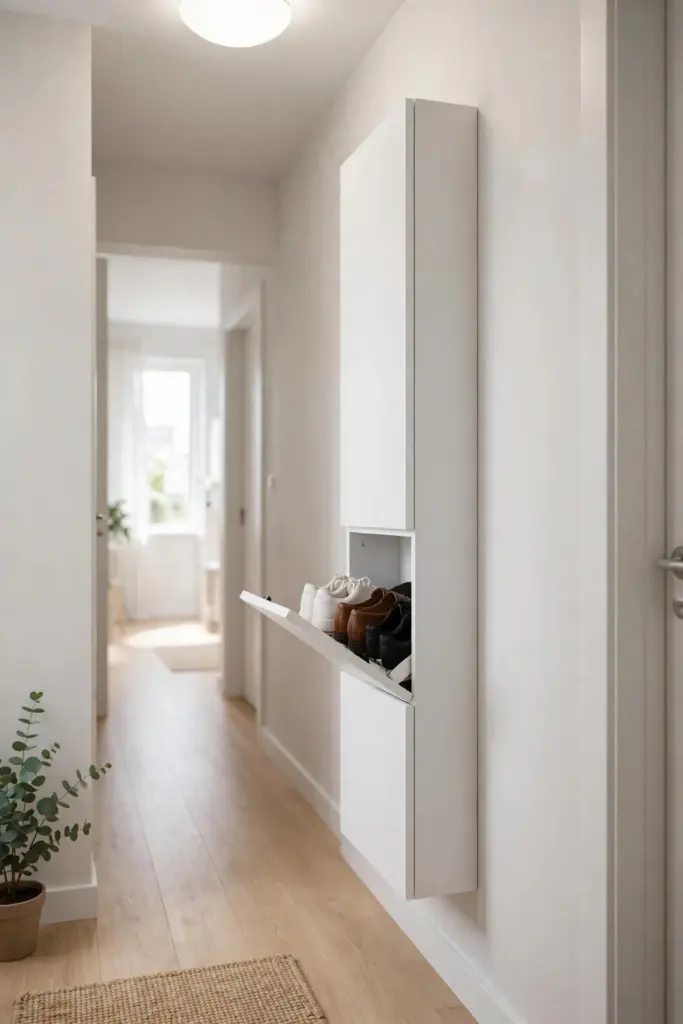
Open shoe racks become visual chaos. A slim closed shoe cabinet (the tilt-out kind) hides 6 to 12 pairs behind clean doors and it’s only 6 to 8 inches deep — hallway-friendly.
This is the upgrade from “shoes exist” to “shoes are invisible.” $50 to $90. If that’s steep, a lidded bench or even a large lidded basket does the same hiding job for less.
5. The Wall-Mounted “Command Center” (Adhesive)
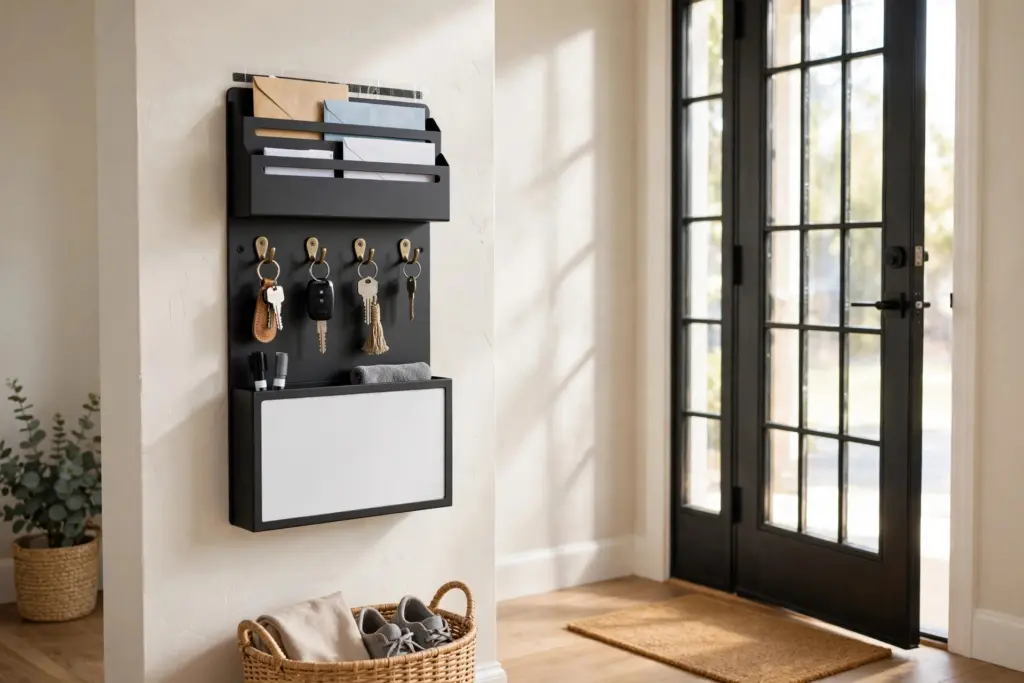
A small adhesive-mounted shelf or wall organizer near the door becomes mission control: tray for keys and wallet, slots for mail, a hook for the mask/sunglasses you always forget.
Keep it minimal — this is a launch pad, not a storage unit. If it accumulates more than keys, wallet, and today’s mail, it’s too big. $15 to $25.
6. A Rolling Cart as a Mobile Entryway
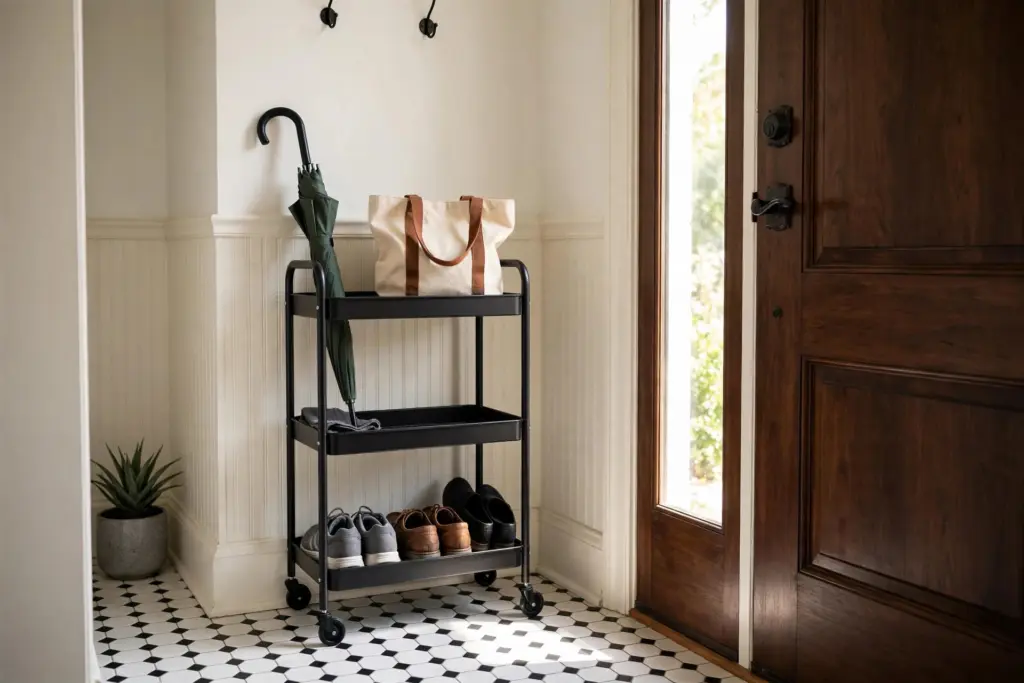
No wall space at all? A 3-tier rolling cart parks by the door and holds everything: top tier for keys and daily stuff, middle for bags and accessories, bottom for shoes.
The wheels mean it tucks into a closet or corner when guests come. $25 to $40, and it relocates to the bathroom or kitchen when your next apartment has a real entryway.
7. A Tension Rod + Curtain “Closet”
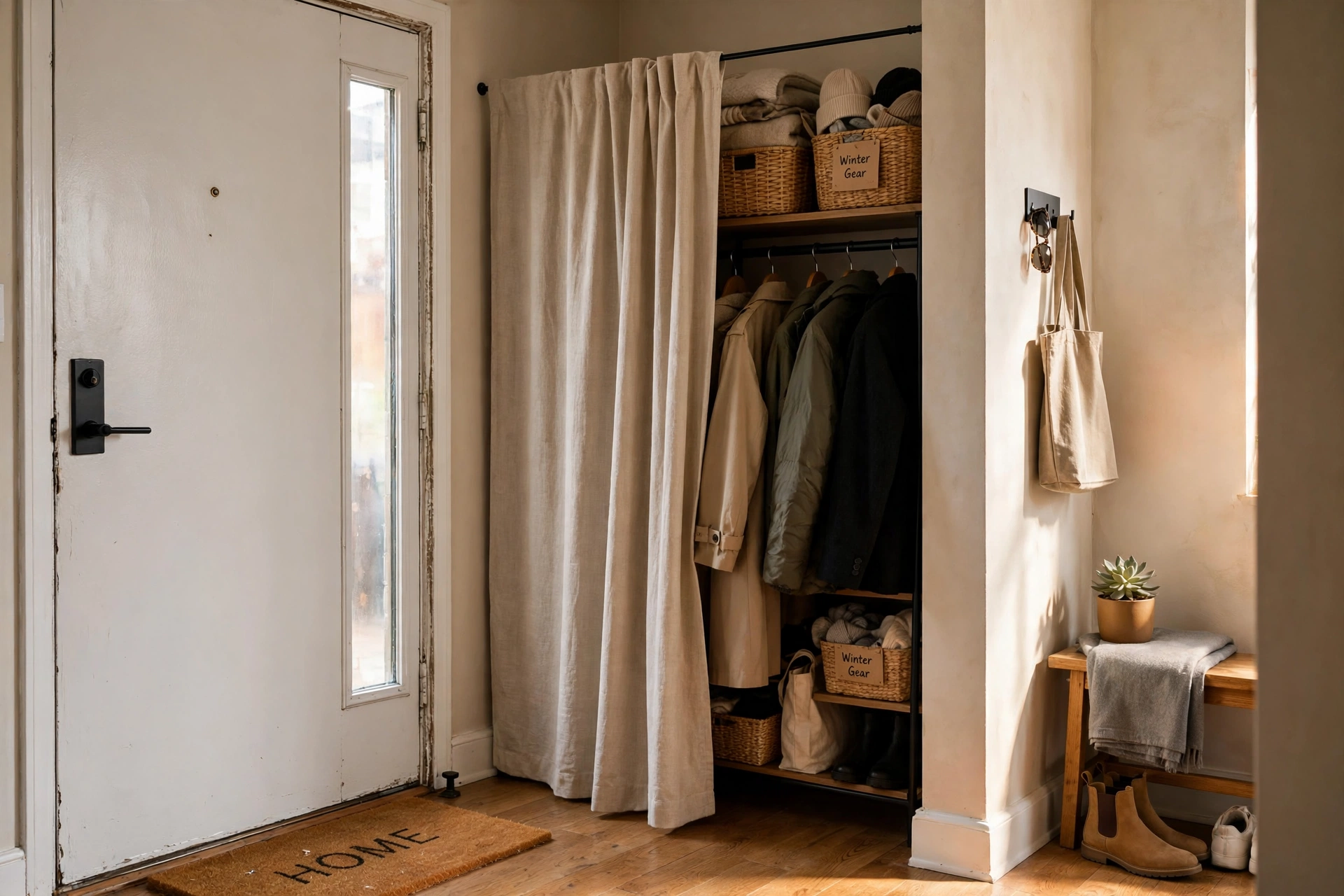
Got a small nook or alcove near the door? A tension rod + curtain creates an instant hidden closet. Hang jackets on a freestanding rack behind it, stash shoes below — close the curtain and it’s a wall.
This is the closest thing to conjuring a coat closet from nothing. Tension rod $10, curtain $15, and suddenly the mess has a door. Works in any alcove 24 to 48 inches wide.
8. Over-the-Door Hooks (The Rental Classic)
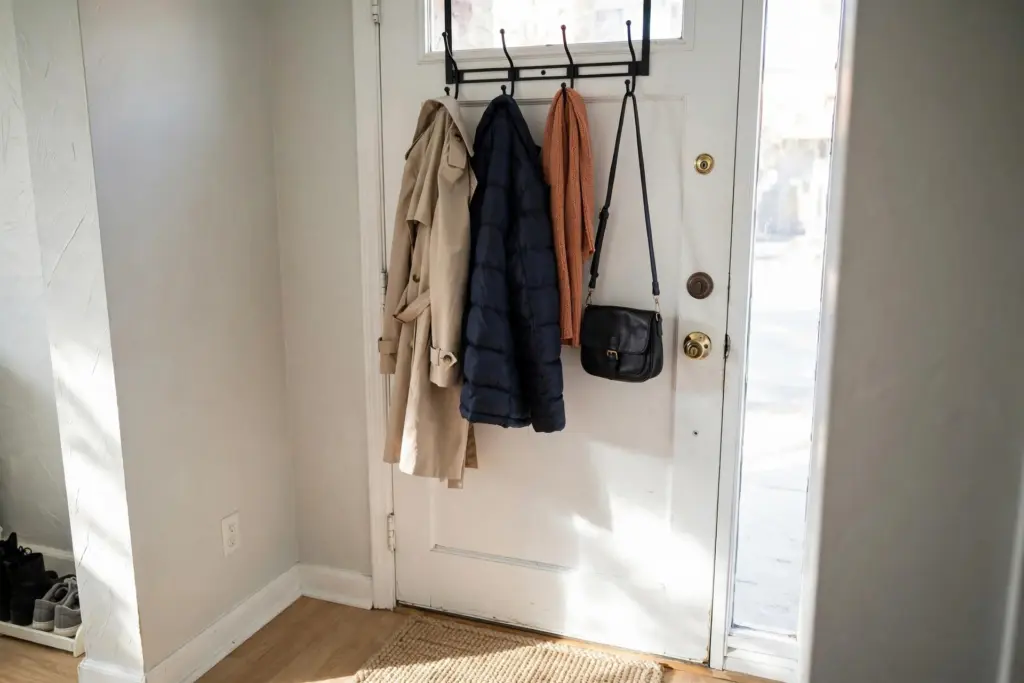
The back of the entry closet door — or the front door itself — holds an over-the-door hook rack for jackets, bags, and tomorrow’s outfit. No adhesive, no drilling, instant.
Check door clearance first: some doors sit too tight to the frame for the brackets. The flat-bracket kind fits most; the thick padded kind doesn’t. $12 to $20.
Front-door caveat: check your lease about hanging things on the front door — some buildings care, most don’t. Inside of the door is always safer than outside.
9. A Boot Tray for Wet Days
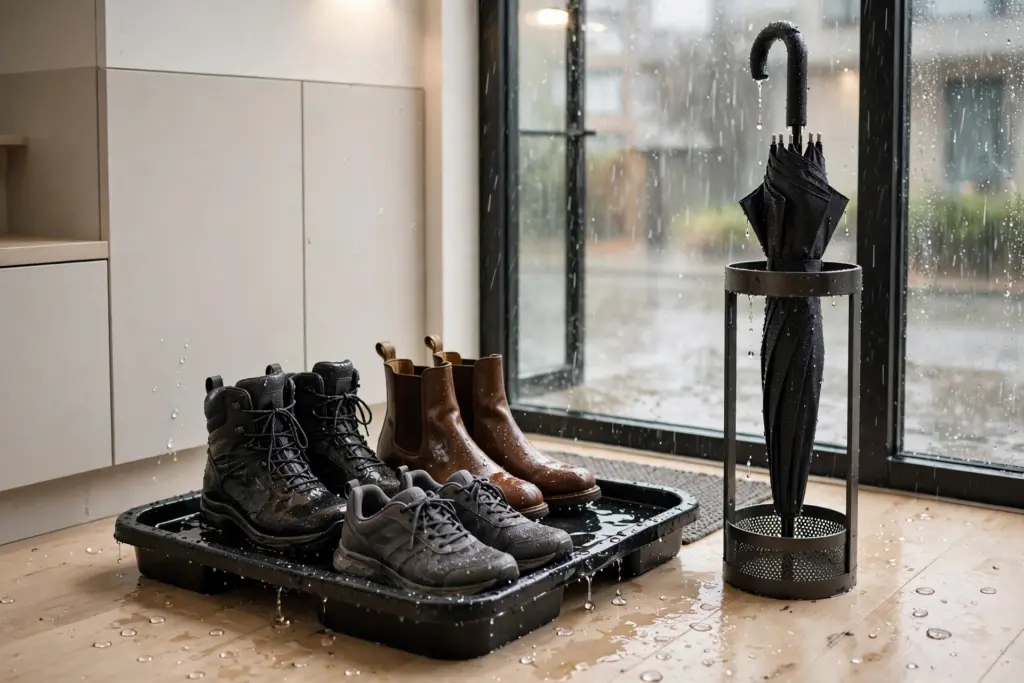
Shoes are manageable until it rains. Then the entryway becomes a swamp. A boot tray by the door contains the water, mud, and salt — and protects the floors, which protects your deposit.
$12 to $18 for a tray that holds 2 to 3 pairs. It’s seasonal furniture: deploy in wet months, stash under the bench in summer. Your landlord’s floors will thank you.
10. The “One In, One Out” Rule
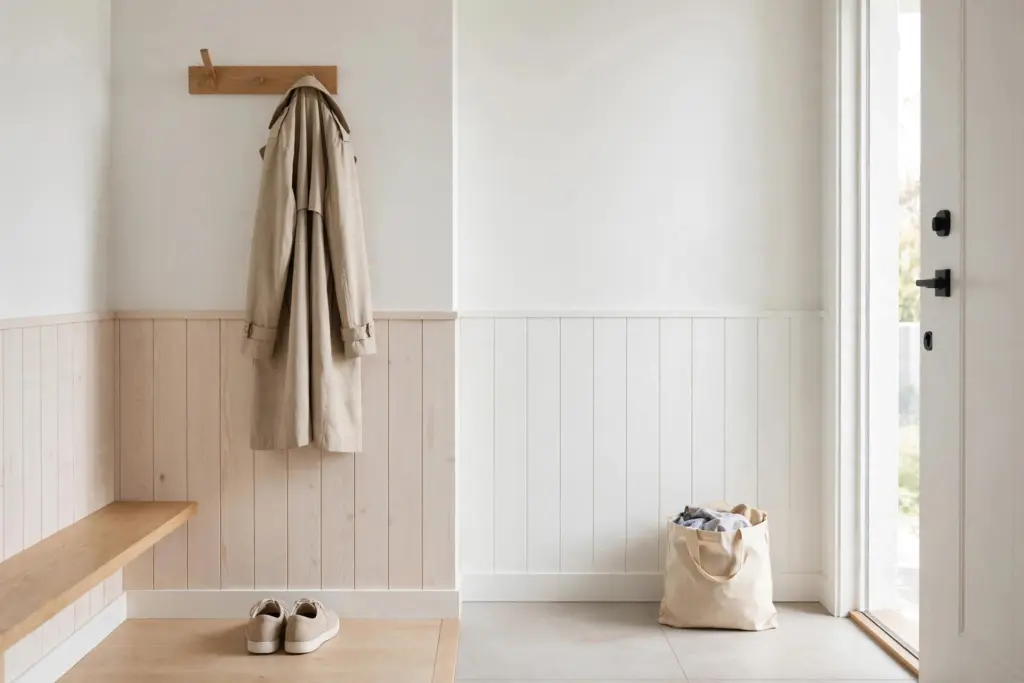
No organizer survives accumulation. The entryway rule: every new jacket, bag, or shoe pair means one leaves (donated, stored elsewhere, relocated). Small entryways have a hard capacity — respect it.
Do a 5-minute entryway reset weekly: shoes back in homes, mail sorted, jackets that migrated to chairs returned. It’s the cheapest organizer on this list and the one most people skip.
The $75 No-Closet Starter Kit
- Freestanding coat rack ($25–$50) — the closet replacement
- Adhesive hook strip ($10–$15) — keys, bags, daily jacket
- Boot tray ($12–$18) — floor protection
- Small tray or bowl ($8) — the key home
Total: roughly $55 to $90. The storage bench ($40–$80) is the big upgrade when budget allows — it replaces the rack AND adds shoe storage.
4 Mistakes That Keep the Pile Alive
Storing off-season stuff at the door. Winter coats in July don’t live in the entryway — they live in a closet, under the bed, anywhere else. The entryway holds this week’s stuff only.
No shoe limit. Pick a number (your tray or cabinet capacity) and enforce it. Shoe 13 lives in the bedroom. Limits are the system.
The chair. Every apartment has a chair that becomes a closet. If you have a chair near the door, it’s not a chair — it’s a pile with legs. Move it or commit.
Buying closed storage you can’t see into. For daily grab-and-go, open hooks beat closed cabinets. You need to see the jacket to grab the jacket. Closed storage is for shoes and off-season; open hooks are for today.
The First 30 Minutes
New apartment, no closet, boxes everywhere? Do this first: (1) put up the adhesive hook strip by the door (10 min) — jackets and bags off the floor immediately; (2) set the boot tray down (1 min); (3) place the key tray (1 min); (4) position the coat rack or bench (5 min); (5) hang today’s jacket, park today’s shoes, drop the keys in the tray. The pile never gets a chance to form because the system beat it by half an hour.
Entryway Layouts for 3 Common Apartment Shapes
The hallway nook (most common): a shallow alcove 2 to 3 feet wide. Hook strip on the wall, slim shoe cabinet below, tray on top. Everything vertical, nothing sticking out into the walkway.
The open-plan studio (door opens straight into the living room): no walls to work with. A storage bench with its back to the room CREATES the entryway — coat rack behind it, landing strip on the bench top. The bench is the entryway.
The long corridor: depth is your friend. Shoe cabinet along one wall, hooks on the other, boot tray at the door end. Keep the middle clear — corridors become obstacle courses fast.
The truly zero-space entryway: some micro-apartments give you a door and about 12 inches of wall. Then it’s one over-the-door hook rack (6 hooks, zero footprint), one slim adhesive key/mail holder, shoes in the bedroom closet. That’s the whole system — about $25, zero floor space used.
The Seasonal Swap (Twice a Year, 2 Minutes)
Entryways fail when summer stuff and winter stuff compete for the same hooks. Twice a year, do the swap: heavy coats, boots, scarves and gloves go to the closet or under-bed storage; light jackets and everyday shoes take their place. The entryway holds THIS season only. Off-season gear at the door is clutter with a calendar excuse.
When Two People Share One Entryway
Double the hooks, not the furniture. Each person gets: 2 to 3 hooks (labeled or color-coded), one shoe cubby or cabinet section, and half the key tray. The shared rule: if your stuff doesn’t fit your half, it doesn’t live at the door. Couples and roommates who skip this conversation end up with one person’s pile and one person’s resentment.
The 5-Minute Weekly Reset (Make It Stick)
Tie the reset to something you already do — taking out the trash, Sunday coffee. Set a phone reminder for the first month until it’s habit. The reset: shoes back to their homes, mail sorted, jackets that migrated to chairs returned, tray wiped. Five minutes. Remember: the system isn’t the furniture. The system is the reset.
What NOT to Buy
- A coat rack taller than your ceiling clearance. Measure — some “tall” racks don’t fit under low entry ceilings or bulkheads.
- Open shoe racks for the entryway. They become visual chaos in the first room guests see. Closed storage hides; open racks display the mess.
- Tiny key bowls. A bowl the size of a coin dish can’t hold keys + wallet + sunglasses. Get a tray at least 8 inches wide or it overflows by day three.
- Bulky umbrella stands. Unless you own four umbrellas, a single adhesive hook holds the one you actually use.
The Move-Out Reset
Hooks peel off with a little heat, the curtain rod twists down by hand, the rack and bench walk out the door. Patch nothing, spackle nothing — there are no holes to fix. Photograph the clean entryway for your deposit file.
Lighting the Entryway (No Wiring Needed)
Most rental entryways have one sad overhead bulb — or none at all. Battery LED puck lights ($10 for a 6-pack) stick under a shelf or inside the shoe cabinet with adhesive: tap on, tap off. Add a motion-sensor night light by the door and you’ll never fumble for keys in the dark again. Good lighting makes a small entryway feel bigger and safer, and it’s the first thing guests notice.
The Guest-Ready 60-Second Tidy
Someone texts “I’m outside.” Sixty seconds: shoes into the cabinet, jackets on hooks (not the chair), mail into the wall file, tray wiped. That’s the whole routine — the entryway is the first thing guests see, and the system makes it presentable in under a minute. Do it once and it becomes reflex.
FAQ
How do you organize an entryway with no coat closet?
Build a three-home system near the door: hooks or a rack for jackets/bags, a bench or cabinet for shoes, and a tray for keys. Freestanding and adhesive options need zero drilling.
Where do you put coats when renting without a closet?
A stable freestanding coat rack, adhesive wall hooks, or a tension-rod-and-curtain nook that hides a rack. Keep only this week’s coats at the door; store off-season elsewhere.
How do I keep shoes organized in a small apartment entryway?
A slim tilt-out shoe cabinet hides 6–12 pairs in 6 inches of depth. Set a pair limit matching your storage, and keep a boot tray for wet days.
Can I hang things on walls in a rental entryway?
Yes — removable adhesive hooks and strips hold 3–5 lbs per hook on smooth walls and remove cleanly. For heavier items, use freestanding furniture instead.
What’s the cheapest way to create an entryway closet?
A tension rod ($10) + curtain ($15) across a small nook, with a freestanding rack behind it. Under $30 total for a hidden “closet.”
How do I stop the entryway from getting messy again?
The weekly 5-minute reset plus the “one in, one out” rule. No organizer survives without maintenance — the system is the reset, not the furniture.
How do I organize a shared entryway with a roommate?
Split it down the middle: each person gets their own hooks, shoe space, and half the key tray. Label zones and agree that overflow doesn’t live at the door — it lives in your room.
Where should an entryway “zone” go if my door opens straight into the living room?
Build it with furniture, not walls: a storage bench with its back to the room marks the boundary, with a coat rack behind it and the landing strip on top. A rug under the bench reinforces the zone visually.
Can I use the back of my front door for storage?
Yes — over-the-door hook racks need no drilling and hold jackets, bags, and tomorrow’s outfit. Check the door still closes fully with the brackets on, and use the inside of the door rather than the outside for lease safety.
My entryway has no light. What can I do without wiring?
Battery-powered LED puck lights stick anywhere with adhesive — under a shelf, inside a shoe cabinet, above the hooks. A motion-sensor night light near the door means no more fumbling for keys in the dark.
No coat closet isn’t a storage problem — it’s a zoning problem. Give everything a home within arm’s reach of the door, enforce the shoe limit, and the pile never forms. Start with the hooks; they’re $12 and they change everything.
Loved this? Pin it so you can find it later.
Pin this post
Zoya Siddiqui
Hi, I'm Zoya Siddiqui, the founder of Shutki. I live in small rental spaces and share practical, renter-friendly storage ideas for tiny kitchens, bedrooms, closets, and bathrooms — no drilling, no renovations, no lost security deposit.
All posts